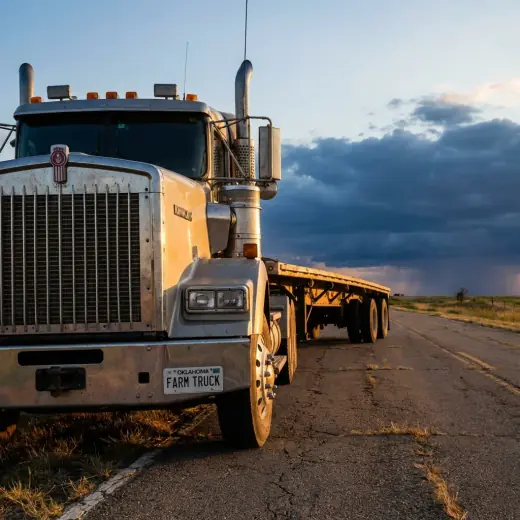
Some farm trucks are exempt from federal CDL, drug-testing, medical-card, hours-of-service and maintenance rules. Oklahoma treats the whole year as planting and harvest season, so many farm hauls within 150 air miles have no hours limits. Those exemptions do not remove the federal rule against driving while too tired or ill, or the cargo-securement rules.
Is this a case for a lawyer?
If someone was badly hurt or killed, and a person, company, or agency may be at fault, it is worth having a lawyer look at it.
Case focus
Farm and Livestock Truck Crashes in Oklahoma
A lawyer looks at what happened, what proof exists, and what the losses are.
Attorney review
Contact a lawyer
Use the contact form, or call (405) 759-0515 and talk with a lawyer.
When to ask a lawyer to review your case
Call a lawyer if someone was killed or badly hurt, if a company or a government agency may be responsible, or if the other side disputes what happened. You do not need to know whether you have a case. Tell us what happened. A lawyer will look at it.
Tell a lawyer what happened.
If someone died or was badly hurt, a company was involved, or you are worried evidence could be lost, fill out the form below or call the firm.
01
What counts as a covered farm vehicle
Federal rules define a covered farm vehicle as a straight truck or articulated vehicle that has a farm plate or other state farm designation, is operated by the owner or operator of a farm or ranch or by their employee or family member, hauls agricultural commodities, livestock, machinery or supplies to or from a farm or ranch, and is not used in for-hire motor carrier operations (49 CFR 390.5T). A tenant hauling the landlord's share of the crops under a crop-share farm lease is not treated as for-hire for this purpose.
Weight decides where the farm exemptions reach. A covered farm vehicle rated at 26,001 pounds or less may use them anywhere in the United States. A heavier one may use them anywhere in its state of registration, or across state lines within 150 air miles of the farm or ranch (49 CFR 390.5T). The older section, 49 CFR 390.5, has been suspended since July 21, 2026, so 390.5T is the text in force.
A for-hire grain or cattle hauler is not a covered farm vehicle, because the definition excludes for-hire motor carrier operations (49 CFR 390.5T). That does not mean a for-hire hauler has no exemption. FMCSA says the harvest-season hours exemption described below applies to both private and for-hire carriers. Separately, federal rules treat a truck used on a highway in interstate commerce as a commercial motor vehicle when it is rated or weighs 10,001 pounds or more (49 CFR 390.5T).
02
What the farm exemption removes, and what it keeps
For a covered farm vehicle and its driver, federal rules lift the commercial driver's license requirement, drug and alcohol testing, the physical qualification and medical examination rules, the hours-of-service rules, and the inspection, repair and maintenance rules (49 CFR 390.39(a)).
That list does not include Part 392, the federal driving rules, or Part 393, which covers parts and accessories, including cargo securement. Under 49 CFR 392.3, no driver may operate a commercial motor vehicle while too impaired by fatigue, illness or any other cause to drive safely, and a motor carrier may not require or permit it (49 CFR 392.3). A separate allowance for state rules does not apply to a covered farm vehicle hauling hazardous materials that require a placard (49 CFR 390.39(b)(2)); see hazmat truck crashes.
03
Hours of service for grain and cattle haulers
During planting and harvesting periods set by each state, the federal hours-of-service rules do not apply to drivers hauling agricultural commodities, farm supplies or livestock within a 150 air-mile radius (49 CFR 395.1(k)). The radius is measured from the source for agricultural commodities, from the distribution point for farm supplies, and, for livestock, from the final destination of the livestock.
FMCSA explains that, since November 15, 2021, livestock haulers may use the 150 air-mile exemption at the end of a trip as well. In FMCSA's words, the hours rules are not in effect for livestock haulers between a point 150 air miles from the source of the livestock, "typically a sales barn," and a point 150 air miles from the place where the livestock will be delivered.
FMCSA says this exemption applies to both private and for-hire carriers, that the hours rules apply once a driver operates beyond the 150 air-mile radius, and that "the driver has the burden of proof" to show the exemption applied (FMCSA, ELD Hours of Service (HOS) and Agriculture Exemptions, last updated December 21, 2023).
The Oklahoma Highway Patrol's Troop S, its commercial vehicle enforcement unit, says Oklahoma's planting and harvesting season for this federal relief runs January 1 to December 31 (OHP Troop S Agriculture page, last modified Jan 08, 2025). The 30-minute break rule does not apply to a driver hauling livestock interstate while the livestock are on the vehicle (49 CFR 395.1(v)), and the hours rules do not apply to drivers of covered farm vehicles (49 CFR 395.1(s)). For hours rules on other trucks, see truck driver fatigue.
04
Records that still exist
Because the driver has to show an exemption applied, trip records matter: where the load started, where it was going, and the air-mile distances; the farm plate and registration; dispatch and load records; and driver statements. Useful early questions include whether the truck had a farm plate, whether it was hauling for hire, where the trip started and was headed, how far that was in air miles, and whether the load required a hazardous-materials placard. Each answer can change which federal rules applied. Some records are kept only for a short time, so a written preservation request may help; see trucking spoliation of evidence. For loose or shifting loads, see truck rollover crashes and overloaded truck crashes. For crashes around Enid and Garfield County, see Enid truck accidents.
05
Who may be responsible
Federal rules bar a motor carrier from requiring or permitting a driver to operate while too fatigued or ill to drive safely (49 CFR 392.3). Who else may be responsible depends on the facts of the crash. See the truck accident hub.
06
About the reviewing attorney
Jason Hicks is an Oklahoma trial lawyer who obtained a $126M jury verdict.
Have Jason Hicks review your crash at no charge.
Jason Hicks is an Oklahoma truck-wreck trial lawyer.
07
Sources
- 49 CFR 390.5T (last amended 91 FR 45661, July 21, 2026); 49 CFR 390.5 suspended indefinitely effective July 21, 2026.
- 49 CFR 390.39 [78 FR 16194, Mar. 14, 2013, as amended at 81 FR 47720, July 22, 2016].
- 49 CFR 395.1(k), (s), (v) (last substantive version 2024-11-18).
- 49 CFR 392.3 [35 FR 7800, May 21, 1970, as amended at 60 FR 38746, July 28, 1995].
- FMCSA, ELD Hours of Service (HOS) and Agriculture Exemptions (last updated December 21, 2023).
- Oklahoma Highway Patrol Troop S, Agriculture (last modified Jan 08, 2025).
This is general information, not legal advice for your situation.
Evidence and Next Steps
Use these resources to move from general information to the records, proof, and case-review steps that fit the matter.
Contact a lawyer
If a deadline is close or records could be lost, a lawyer can go over what happened with you.
Contact a lawyerCase Results
Read about past cases the firm has handled. Past results do not guarantee a similar outcome.
Case ResultsHicks Legal Journal
Use supporting analysis and client-facing reference material to understand the next evidence and timing issues.
Hicks Legal JournalClient Guides
Use supporting analysis and client-facing reference material to understand the next evidence and timing issues.
Client GuidesResource Library
Use supporting analysis and client-facing reference material to understand the next evidence and timing issues.
Resource LibraryPersonal Injury Overview
Open the next resource that best matches this farm and livestock truck crashes in oklahoma case.
Personal Injury Overview