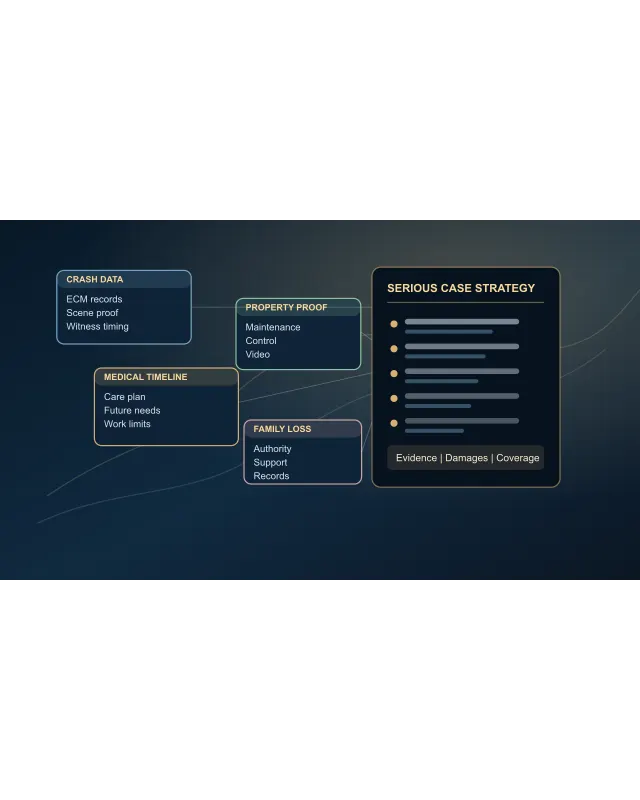
What to decide first
Confirm whether the harm, defendant, damages, and proof point toward a case that needs attorney review.
Case focus
Oklahoma High-Value Injury Litigation
High-value negligence cases require early evidence control, defendant mapping, damages work, and trial-level review.
Proof track
Death, surgery, brain injury, paralysis, amputation, burn injury, or permanent impairment.
Trucking company, fleet operator, business, insurer, property owner, or other defendant with records to preserve.
Attorney review
Request Case Review
Use the case review form or call (405) 759-0515 for direct attorney intake.
When high-value negligence needs attorney review
A high-value case is not just a big number. It often involves life-changing harm, disputed responsibility, meaningful damages, and records that need careful review. This practice area is strongest when the harm, disputed responsibility, damages, and available records support direct attorney review.
Send the key facts for attorney review.
If this involves death, catastrophic injury, a commercial defendant, or evidence that may need preservation, jump to the case-review form or call the firm.
01
What makes a negligence case high-value?
A high-value negligence case usually combines major harm, a defendant with meaningful responsibility, recoverable damages, and proof that can survive pressure. The label does not come from a demand letter. It comes from evidence.
Hicks Law Firm looks for matters involving death, permanent injury, surgery, brain injury, spinal injury, amputation, burns, commercial vehicles, company drivers, disputed fault, missing video, policy failures, or insurance positions that do not match the record.
Vehicle wrecks
Semi-truck wrecks, commercial fleet crashes, catastrophic car crashes, and motorcycle wrecks where fault or damages will be contested.
Wrongful death
Fatal crashes and other preventable deaths requiring family, estate, evidence, and damages analysis under Oklahoma law.
Catastrophic injury
Cases involving surgery, TBI, spinal injury, paralysis, amputation, severe burns, permanent disability, or future medical needs.
Major premises cases
Negligent security, dangerous property conditions, or site-control failures that cause catastrophic injury or death.
02
The first job is evidence control
In a high-value Oklahoma negligence case, delay can change the proof. Vehicles are repaired. Video is overwritten. Company reports are edited. Witness memories fade. Insurance letters become the first organized narrative in the file.
The first review should answer practical questions: who controlled the vehicle, property, policy, employee, insurance file, video system, or maintenance record; what must be preserved; and whether immediate notices or court action are needed.
- Truck and fleet wrecks: ECM data, ELD logs, dashcam footage, maintenance records, driver files, dispatch messages, and inspection records.
- Car and motorcycle wrecks: scene photos, vehicle damage, phone evidence, roadway video, witnesses, 911 audio, medical causation, and insurance coverage.
- Wrongful death: crash records, medical records, employment records, family-loss proof, funeral records, and any evidence showing what happened before death.
- Premises cases: surveillance video, incident reports, security logs, maintenance reports, prior notices, lease or management records, and property-control evidence.
03
How we match high-value negligence cases to the right proof plan
The right starting point depends on the strongest proof issue. A fatal crash may need a wrongful-death plan, a trucking preservation plan, and a catastrophic-damages plan at the same time.
Fatal truck wrecks
Commercial vehicle crashes involving death, carrier records, physical vehicle preservation, and wrongful-death damages.
Fatal car wrecks
Deadly car crashes involving disputed fault, intoxication, distracted driving, policy limits, and family-loss proof.
Fatal motorcycle wrecks
Deadly rider cases where the defense may blame the motorcyclist before the physical evidence is tested.
Catastrophic injury
Permanent injury cases requiring future-care, earning-capacity, medical-causation, and full damages development.
To compare documented outcomes by high-value negligence category, start with high-value negligence results, then review truck crash results, wrongful death results, catastrophic injury results, motorcycle wreck results, and premises results.
04
What to send before review
You do not need to know the legal theory before asking for help. The most useful first information is concrete: where it happened, when it happened, who was involved, what records exist, what injuries or death occurred, and what the insurer or defendant has already said.
Do not send confidential details until an attorney-client relationship has been established. Use the review form to start the conflict check and attorney review process.
Evidence and Next Steps
Use these resources to move from general information to the records, proof, and case-review steps that fit the matter.
Request Case Review
Request a review if records, deadlines, or insurance contact may affect this high-value negligence matter.
Review Request Case ReviewCase Results
Compare documented outcomes that show how similar proof translated into value.
Review Case ResultsHicks Legal Journal
Use supporting analysis and client-facing reference material to understand the next evidence and timing issues.
Review Hicks Legal JournalClient Guides
Use supporting analysis and client-facing reference material to understand the next evidence and timing issues.
Review Client GuidesResource Library
Use supporting analysis and client-facing reference material to understand the next evidence and timing issues.
Review Resource LibraryAttorney Profile
Review trial counsel background and the firm posture behind this practice area.
Review Attorney ProfileTrust Center
Check the firm standards, review process, and proof posture before deciding.
Review Trust CenterPersonal Injury Overview
Open the next resource that best matches this high-value negligence case.
Review Personal Injury Overview