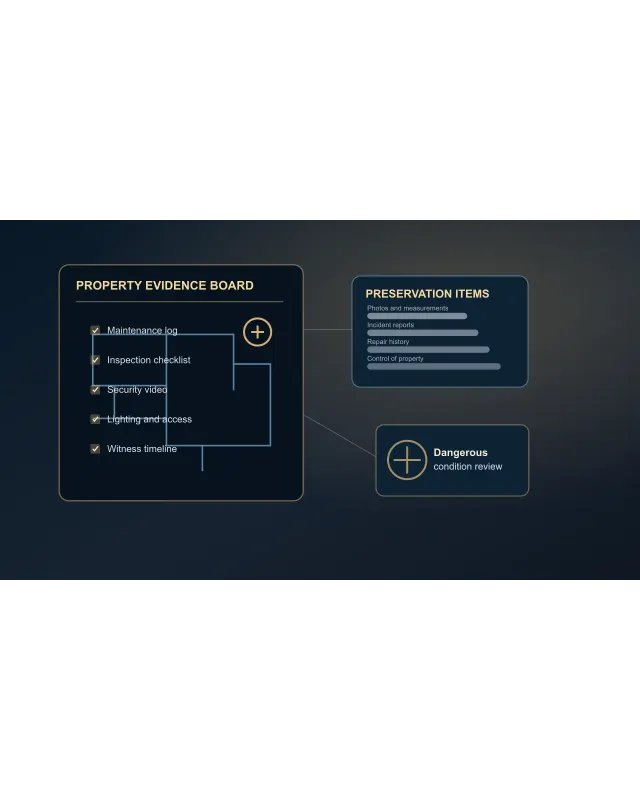
Dangerous-property evidence board with maintenance, inspection, security video, lighting, and witness timeline items

Serious Premises Liability

Serious Premises Liability Review.

Proof priority

Evidence preservation, valuation discipline, and fast attorney review.

Catastrophic injury, death, negligent security, and property-control cases where records and notice evidence matter.

Evidence preservation, valuation discipline, and fast attorney review.

Evidence preservation, valuation discipline, and fast attorney review.

Serious premises cases often turn on property control, notice, surveillance, maintenance records, prior incidents, and whether dangerous conditions were reasonably addressed.

What to decide first

Confirm whether the harm, defendant, damages, and proof point toward a case that needs attorney review.

Case focus

Serious Premises Liability

Catastrophic injury, death, negligent security, and property-control cases where records and notice evidence matter.

Proof track

Evidence preservation

Witness chronology, records collection, and damages framing start early.

Attorney review

Request Case Review

Use the case review form or call (405) 759-0515 for direct attorney intake.

When premises liability needs attorney review

A high-value case is not just a big number. It often involves life-changing harm, disputed responsibility, meaningful damages, and records that need careful review. This practice area is strongest when the harm, disputed responsibility, damages, and available records support direct attorney review.

Send the key facts for attorney review.

If this involves death, catastrophic injury, a commercial defendant, or evidence that may need preservation, jump to the case-review form or call the firm.

01

It Was Not "Just an Accident"

When a business invites the public onto its property, whether it is an apartment complex, hotel, or concert venue, the case often turns on what the owner knew, what records exist, and whether dangerous conditions were reasonably addressed.

At Hicks Law Firm, we rarely handle minor "slip and falls." We focus on Negligent Security and Dangerous Condition cases where property mismanagement leads to catastrophic injury or death.

02

Negligent Security & Violent Crime

If you were attacked, assaulted, or if a loved one was killed at an apartment complex or business, the review should focus on what the owner knew, what security measures existed, and what records are available. We investigate:

  • History of Crime: Did the owner know about prior assaults on the property?
  • Access Control: Were security gates broken for months? Were locks missing?
  • Lighting: Did poor lighting affect visibility, access control, or the ability to deter or document the incident?
  • Security Personnel: Was a guard promised but not present?

03

Dangerous Industrial Conditions

We also represent workers and visitors injured by structural failures, including:

  • Deck & Balcony Collapses: Rotting wood left unmaintained.
  • Falling Merchandise: Improperly stacked pallets in warehouse stores.
  • Electrocution: Exposed high-voltage wiring.

04

Investigate The Property

We send preservation letters to secure evidence before ordinary retention practices, repairs, or ownership changes make the record harder to prove:

  • Surveillance Video
  • Security Logs
  • Maintenance Records
  • 911 Call History

Evidence and Next Steps

Use these resources to move from general information to the records, proof, and case-review steps that fit the matter.

Request Case Review

Request a review if records, deadlines, or insurance contact may affect this premises liability matter.

Review Request Case Review

Case Results

Compare documented outcomes that show how similar proof translated into value.

Review Case Results

Hicks Legal Journal

Use supporting analysis and client-facing reference material to understand the next evidence and timing issues.

Review Hicks Legal Journal

Client Guides

Use supporting analysis and client-facing reference material to understand the next evidence and timing issues.

Review Client Guides

Resource Library

Use supporting analysis and client-facing reference material to understand the next evidence and timing issues.

Review Resource Library

Attorney Profile

Review trial counsel background and the firm posture behind this practice area.

Review Attorney Profile

Trust Center

Check the firm standards, review process, and proof posture before deciding.

Review Trust Center

Personal Injury Overview

Open the next resource that best matches this premises liability case.

Review Personal Injury Overview

Request Case Review

Attorneys Review Every Submission

Tell Us What Happened

Step 2 of 2

Provide as much detail as possible to accelerate attorney review.

What Happens Next?
  • Attorney review (not a call center).
  • Immediate conflict check.
  • Confidential plan of action.

Request Premises Liability Case Review

Share case facts now so we can begin evidence-preservation and qualification review.

Start with the facts

A clear summary of what happened, who was involved, and what evidence may exist is enough to begin.

Confidential review

The firm reviews your information and responds if the matter appears to fit.

Evidence and timing

Dates, locations, records, photos, video, and witness names help us understand what may need to be preserved.

How to reach you

Tell us how to reach you and when you are available for follow-up.

Contingency-fee representation may be available. Submitting this form does not create an attorney-client relationship.

Phone Review Option

For severe injury, wrongful death, or evidence-loss risk, a phone review may help identify preservation steps.

Call (405) 759-0515

Common Questions

What if I was partially at fault for my fall?

Oklahoma follows comparative fault. You can still recover damages even if partially at fault, but your recovery will be reduced by your percentage of fault.

How long do I have to file a premises liability claim?

In Oklahoma, the statute of limitations for premises liability is generally two years from the date of injury.

Attorney Review Criteria for Premises Liability

We focus on high-impact claims where evidence, legal strategy, and trial preparation materially change outcomes.

This section is designed for families comparing firms based on litigation depth, not marketing volume. Use it to evaluate whether your claim has the severity, proof path, and timeline urgency required for full trial-level development.

When Attorney Review May Be Important

We qualify cases by objective factors that drive recoverable value and courtroom credibility.

  • - Serious injuries with clear medical documentation and ongoing treatment.
  • - Liability facts that require deeper investigation than a routine adjuster review.
  • - Meaningful losses that justify trial-ready case development.

Evidence and Investigation Priorities

We map immediate records that can be lost through short retention windows or delayed disclosure.

  • - Photos, witness statements, and incident reports tied to a clear timeline.
  • - Medical records, specialist opinions, and future-care projections.
  • - Coverage analysis and defendant asset review.

Damages and Value Drivers

We value claims from records and long-term impact models, not quick-adjuster formulas.

  • - Current and future medical burden.
  • - Lost income and loss of earning capacity.
  • - Pain, impairment, and quality-of-life harm.

Defense Tactics and Rebuttal Focus

Anticipating defense themes early protects settlement leverage and trial positioning.

  • - Soft-tissue minimization and surveillance narratives aimed at reducing credibility.
  • - Liability splitting to suppress payout percentages below documented damages.
  • - Deadline pressure around quick releases before full diagnosis is complete.

Evidence Preservation Window and Timeline

High-value litigation depends on preserving digital, medical, and witness evidence early. We start with early preservation notices, then sequence liability and damages proof before defense narratives harden.

Delays can reduce case value. A structured timeline allows us to prove what happened, who knew what, and when each party failed to act. That chronology becomes the foundation for both settlement pressure and trial testimony.

What Happens Next

  1. Confidential attorney review and case screening.
  2. Evidence and damages build-out with experts as needed.
  3. Negotiation followed by litigation if full value is denied.

Damages Documentation Checklist

Serious-value recovery depends on record quality. Keep a disciplined file of provider notes, specialist recommendations, work restrictions, wage-loss records, and day-to-day functional impacts. This record set is often decisive when insurers challenge severity or duration.

We align each damages category with admissible proof so valuation reflects true long-term consequences, not a short-term snapshot created before treatment stabilization.

Liability Framework and Proof

We align every allegation with objective records, timeline evidence, and expert testimony. The goal is not volume; it is documented proof that can withstand aggressive defense motions.

Local Venue and Process Context

Oklahoma venue selection, filing sequence, and early motion practice can materially change leverage. We build each case for the forum that best supports documented recovery.

Common Questions

These questions reflect the most common decision points in high-stakes injury and civil-rights case review.

What makes this type of case high value?

Clear liability plus severe, well-documented damages and credible long-term loss evidence.

How soon should I contact counsel after the incident?

As soon as possible. Early strategy improves evidence quality and protects negotiation leverage.

Can you evaluate future losses before settlement?

Yes. We use records and expert input to model realistic long-term impacts before any release is signed.

Is there any upfront legal fee?

Serious injury cases are reviewed for contingency-fee representation, and the fee terms are explained before representation begins.