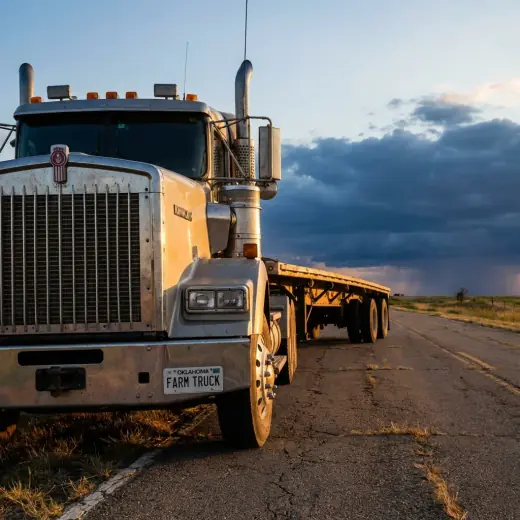
Oilfield trucks (frac-sand haulers, water and produced-water trucks, rig-moving and pipe trucks, and well-service rigs) run under federal hours-of-service exceptions and Oklahoma permit rules that ordinary long-haul freight may not use. The records those rules create, from duty-status annotations to per-load shipping papers and overload permits, are often the starting point for an investigation. Worker-injury questions belong on the oilfield accidents and oil-field injury pages.
What to decide first
Confirm whether the harm, defendant, damages, and proof point toward a case that needs attorney review.
Case focus
Oilfield Truck Crashes in Oklahoma
Fast attorney review, evidence control, and valuation planning for high-stakes cases.
Proof track
Evidence preservation
Witness chronology, records collection, and damages framing start early.
Attorney review
Case Review
Use the case review form or call (405) 759-0515 for direct attorney intake.
When to ask a lawyer to review your case
A high-value case is not just a big number. It often involves life-changing harm, disputed responsibility, meaningful damages, and records that need careful review. This practice area is strongest when the harm, disputed responsibility, damages, and available records support direct attorney review.
Send the key facts for attorney review.
If this involves death, catastrophic injury, a commercial defendant, or evidence that may need preservation, jump to the case-review form or call the firm.
01
The trucks that serve an Oklahoma well site
Frac-sand haulers, water and produced-water trucks, rig-moving and pipe trucks, and well-service equipment all move to and from well sites. In 2013, FMCSA described fracking as requiring “heavy traffic in vehicles hauling sand and water” (78 FR 48817). That is FMCSA’s explanation of the traffic, dated 2013, not a current volume count.
02
Federal hours-of-service exceptions for oilfield trucks
These are general rules, not advice about a particular driver.
Under 49 CFR 395.1(d)(1), for commercial motor vehicles used exclusively in the transportation of oilfield equipment and the servicing of the field operations of the natural gas and oil industry, any period of eight consecutive days may end with at least 24 hours off duty. FMCSA guidance (77 FR 33098, 2012) has described that provision as covering a broad range of commercial motor vehicles in direct support of well sites, including water to the site and waste or product away, without a special design or training requirement.
The waiting-time rule in 49 CFR 395.1(d)(2) is narrower. It applies only to “specially trained drivers” of commercial motor vehicles “specially constructed to service oil wells.” Waiting time at the well site is logged off duty with an annotation and is excluded from the 14-hour window. Those drivers cannot use the short-haul exception in 395.1(e)(1). FMCSA has said that commercial motor vehicles that transport supplies “such as sand and water” to and from well sites do not qualify for the waiting-time provision. Examples that may qualify include wire-line trucks, frac pumps, blenders, and sand storage trailers. A sand storage trailer may qualify; a sand hauler does not.
The short-haul exception in 49 CFR 395.1(e)(1) is a 150 air-mile radius (172.6 statute miles), with the driver back and released within 14 hours and 10 hours off. Those drivers do not use logs or an ELD, but the carrier keeps time records for six months. If a short-haul oilfield driver is involved, those time records are worth preserving promptly. See spoliation of evidence.
Interstate drivers remain subject to the federal hours limits that apply to them. For drivers working solely within Oklahoma, state law allows up to 12 hours of driving (non-hazmat) and does not enforce the 30-minute break (47 O.S. §230.15(D)). The 24-hour oilfield restart and the waiting-time rule do not replace that statutory intrastate note.
03
Oklahoma rules that reach oilfield trucks
47 O.S. § 230.15 directs the Department of Public Safety to set intrastate driving-hour rules, with the statutory exceptions in § 230.15(D) quoted above. The Commissioner of Public Safety may adopt federal motor carrier safety regulations by reference (47 O.S. § 230.4(2)).
Saltwater and other “deleterious substances” are subject to OCC permit rules, including a deleterious-substance transport permit (DSTP) for loads over 20 gallons, a ban on dumping on highways, and a ban on an in-cab release valve on saltwater trucks (OAC 165:30-3-13(a), (c), (d)). Examples in that definition include salt water, oilfield brine, waste oil, and mud (OAC 165:30-1-2). The official definition is broader than this list. Per-load shipping documents must identify the vehicle, driver, shipper, origin, volume, and destination, with a register kept at the principal place of business (OAC 165:30-3-13(g)–(h)). Those papers are evidence.
Oklahoma’s annual special overload permit for oil-field fluids and equipment (and rock, sand, and gravel) allows up to 5 percent over gross and 8 percent over axle limits, at $350 per year, and is not valid on the Interstate system (47 O.S. § 14-109(D)). A permit does not excuse exceeding the permit’s limits. Loads must not drop, sift, leak, or blow, and sand loads must be covered (47 O.S. § 14-105(A)–(B)).
04
What the crash data can and cannot show
FARS has no oilfield code.
County fatal-crash figures below are all large-truck fatal crashes in the county, on all roads, with all cargo, not oilfield-only (NHTSA FARS 2020–2023 final and 2024 preliminary data, queried October 28, 2026). FARS recorded 18 fatal crashes in Canadian County involving an in-transport large truck, with 22 deaths (2020–2024); 15 fatal crashes in Grady County, with 18 deaths; and 4 fatal crashes in Kingfisher County, with 6 deaths. Those numbers are not oilfield-truck counts.
Statewide cargo-tank figures (FARS cargo-body code 2) count every tanker type statewide (fuel, LPG, chemicals, crude, and others), not oilfield or frac-sand trucks.
05
Who may be responsible, and what to preserve
Depending on the facts, responsibility may involve the driver; the motor carrier or hauling contractor; the operator or service company that dispatched the load; a sand or water supplier; an equipment lessor; or a maintenance shop. See the broker liability and overloaded truck pages.
Evidence that may matter includes the DSTP and per-load shipping documents, short-haul time records, duty-status records with waiting-time annotations, the overload permit, scale tickets, dispatch and well-site logs, ECM and ELD data, and maintenance records. See truck accident investigation.
Related pages: the truck accident hub and what to do after a truck crash.
06
About the reviewing attorney
Jason Hicks is a battle-tested Oklahoma trial lawyer who won a $126 million jury verdict.
We handle cases on a contingency fee. If there’s no recovery, there’s no fee. We front the case costs.
Have Jason Hicks review your crash at no charge.
Jason Hicks is an Oklahoma truck-wreck trial lawyer.
07
Sources
- 49 CFR 395.1(d)(1), (d)(2), (e)(1); 78 FR 48817 (2013); 77 FR 33098 (2012).
- 47 O.S. §§ 14-105, 14-109(D), 230.15(D), 230.4(2); OAC 165:30-1-2, 165:30-3-13.
- NHTSA FARS county and cargo method notes
This is general information, not legal advice for your situation.
Evidence and Next Steps
Use these resources to move from general information to the records, proof, and case-review steps that fit the matter.
Request Case Review
Request a review if records, deadlines, or insurance contact may affect this oilfield truck crashes in oklahoma matter.
Review Request Case ReviewCase Results
Compare documented outcomes that show how similar proof translated into value.
Review Case ResultsHicks Legal Journal
Use supporting analysis and client-facing reference material to understand the next evidence and timing issues.
Review Hicks Legal JournalClient Guides
Use supporting analysis and client-facing reference material to understand the next evidence and timing issues.
Review Client GuidesResource Library
Use supporting analysis and client-facing reference material to understand the next evidence and timing issues.
Review Resource LibraryAttorney Profile
Review trial counsel background and the firm posture behind this practice area.
Review Attorney ProfileTrust Center
Check the firm standards, review process, and proof posture before deciding.
Review Trust CenterPersonal Injury Overview
Open the next resource that best matches this oilfield truck crashes in oklahoma case.
Review Personal Injury Overview