Tulsa, Tulsa County
Tulsa High-Value Negligence Attorneys
Serious negligence representation for fatal crashes, catastrophic injuries, truck wrecks, motorcycle wrecks, and major premises cases requiring early proof control.
What to review first in Tulsa
Start with the local facts, then focus on liability, damages, available records, and whether attorney review should begin early.
Local venue
Tulsa, Tulsa County
Tulsa County Courthouse, 500 S Denver Ave
Case focus
High-Value Negligence
Serious negligence representation for fatal crashes, catastrophic injuries, truck wrecks, motorcycle wrecks, and major premises cases requiring early proof control.
Attorney review
Request Case Review
Use the review form below or call (405) 759-0515 to discuss records, video, or witness details that may need preservation.
When Tulsa high-value negligence needs attorney review
A high-value case is not just a big number. It often involves life-changing harm, disputed responsibility, meaningful damages, and records that need careful review. Local facts matter, but the real question is whether the harm, defendant, damages, and proof support trial-level review.
Send the Tulsa facts while records are still identifiable.
Include where it happened, who was involved, the injury or death, and whether video, vehicles, records, or witnesses may need attention.
Insurance Alert: Time-sensitive evidence can disappear quickly. Early attorney review can identify preservation steps before routine retention periods expire.
Do You Qualify for High-Value Negligence Representation in Tulsa?
Serious Tulsa cases often involve permanent impairment, complex treatment, major liability disputes, or records controlled by another party. Early review can identify the evidence and documentation needed before routine retention periods expire.
Families across Tulsa County can face settlement pressure before liability and damages are fully documented. A careful review should identify proof gaps, available records, and the damages information needed for an informed decision.
If your incident occurred near I-44, US-75, US-169, BA Expressway, at a commercial site, in a construction zone, or in any setting where multiple actors may share responsibility, the file should be documented well enough to withstand aggressive defense scrutiny rather than a quick-value shortcut.
- death, surgery, permanent impairment, brain injury, spinal injury, severe burns, amputation, or major wage-loss exposure
- commercial, corporate, fleet, insurer, property-control, or multi-defendant responsibility that will be disputed
- records, video, vehicle data, incident reports, witness accounts, or company policies that may need preservation
- defense pressure, early insurer contact, or incomplete reporting before the full harm is known
Liability Framework and Proof Requirements
Liability is built through objective chronology, not assumptions. We align incident records, witness sequencing, physical evidence, and institution-specific records so each defense narrative can be tested against a consistent timeline.
In high-value files, proof quality affects valuation. Our team identifies potentially responsible actors, isolates breach points, and prepares rebuttal evidence before defense counsel defines the frame for mediation or suit.
For Tulsa cases, this means matching local incident context with statewide litigation standards and preserving a case theory that can survive both adjuster review and courtroom examination in Tulsa County.
- defendant mapping across drivers, companies, property controllers, insurers, contractors, and other negligent actors
- fault proof tied to objective records rather than an early insurance narrative
- comparative-fault rebuttal prepared before blame-shifting hardens
- trial-level chronology connecting duty, breach, causation, and damages
Start Case Review
If evidence may be at risk, prompt attorney review can help identify preservation steps before records, video, or witness details change.
Evidence Preservation Window and Action Timeline
Evidence risk can begin early. Video retention limits, record overwrites, and witness drift can reduce case value before the legal process even starts. We use preservation-first intake to identify critical proof before routine deletion windows close.
Our early timeline protocol captures records in a sequence that supports both liability and damages: incident documentation, medical chronology, economic-loss records, and defense-position tracking. That sequence prevents fragmented files that insurers exploit.
Where agencies or institutions control key records, we escalate preservation demands quickly and build a documented chain showing what was requested, when it was requested, and what was produced.
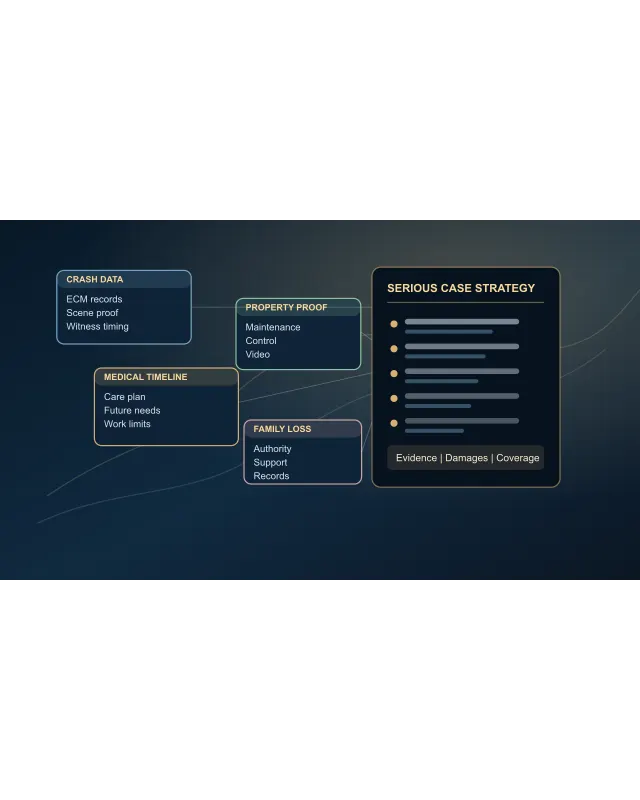
- scene photos, vehicle data, video, incident reports, witness names, and emergency-response records
- company policies, maintenance records, dispatch messages, personnel files, and insurance communications where relevant
- medical records, diagnosis timing, surgery recommendations, and future-care indicators
- family-loss, wage-loss, and life-impact documentation tied to the harm actually caused
Damages Model: Economic, Non-Economic, and Case Factors
Damages valuation is not a single number; it is a documented model. We quantify measurable economic losses, build future-cost projections when supported, and align every category of harm with records that can hold up under cross-examination.
Non-economic harm is equally important in high-severity files. We frame pain burden, loss of normal life, and family-impact disruption with concrete chronology, not generalized language, so valuation reflects real case depth rather than a formula payout.
For families in Tulsa, a complete damages model is often the difference between an early lowball proposal and meaningful settlement movement backed by credible trial risk.
- past and projected medical costs supported by treatment records and specialist input
- lost wages, earning-capacity disruption, and household-service losses
- permanent impairment, pain burden, activity loss, and family impact
- wrongful-death damages where a fatal event requires estate and family-loss review
Defense Tactics and Rebuttal Strategy
High-value defendants usually run predictable pressure tactics: deny core facts early, delay meaningful offers, and narrow the case before full records are assembled. We anticipate those patterns and build rebuttal evidence before they mature.
Our trial-preparation model addresses narrative attacks, causation disputes, and valuation suppression with a structured response file that can be deployed in negotiation, mediation, and litigation filings.
By the time defense counsel pushes alternative explanations, the case should already include a clear chronology, verified records, and a disciplined damage model that limits room for distortion.
- comparative-fault inflation and incomplete police-report framing
- pre-existing-condition arguments used to discount serious injury
- record gaps created by delayed preservation or selective production
- early low-value settlement pressure before damages are fully documented
Local Venue and Process Context in Tulsa County
Local process context matters. We prepare cases for proceedings tied to Tulsa County Courthouse, 500 S Denver Ave and coordinate strategy around venue-specific timelines, filing requirements, and discovery pressure points.
When the claim involves a commercial entity, government roadway, or multi-defendant scenario, early preservation review can identify fleet records, surveillance footage, and maintenance logs before routine retention, repair, or review practices affect the proof.
Our objective is simple: prepare a file that is locally grounded, evidence-ready, and documented without sacrificing compliance or evidentiary integrity.
- Venue planning anchored to Tulsa County Courthouse, 500 S Denver Ave and county-specific process timing
- Early records strategy for local agencies, businesses, and institutional defendants
- Trial-readiness posture maintained through negotiation and pre-suit phases
- Clear client communication cadence with documented milestones and next actions
Damages and Recovery Review
Potential recovery categories may include:
- Medical treatment, surgery, rehabilitation, and projected future-care needs
- Lost income, earning-capacity reduction, and household-service impact
- Wrongful-death losses, family impact, and funeral-related expenses where applicable
- Pain burden, functional limits, and loss of normal life tied to record evidence
- Out-of-pocket expenses and insurance issues connected to the incident
FAQ for Tulsa Families
What makes a negligence case high value?
Serious harm, disputed responsibility, meaningful insurance or defendants, and proof that can withstand pressure are the usual signals.
Does every injury case need this level of review?
No. This level of review is for serious matters involving death, permanent injury, commercial or institutional responsibility, or evidence risk.
Why does early evidence control matter?
Video, vehicle data, records, and witness details can change or disappear before settlement value is clear.
Can disputed fault still support review?
Yes. Disputed fault is common in high-value negligence cases and should be tested against objective proof.
Authority and Case Resources
Use these resources while we review the records, damages, and preservation issues.
Contact Hicks Law Firm
Request review if records, deadlines, or insurance contact may affect the Tulsa matter.
Review Contact Hicks Law FirmCase Results
Compare documented outcomes that show how major claims were valued and framed.
Review Case ResultsHigh-Value Results
Review documented high-value negligence outcomes involving catastrophic injury, fatal loss, and disputed proof.
Review High-Value ResultsTruck Crash Results
Review commercial-vehicle outcomes where trucking records, driver files, and crash proof mattered.
Review Truck Crash ResultsWrongful Death Results
Review fatal-injury outcomes and the proof used to frame family loss.
Review Wrongful Death ResultsCatastrophic Injury Results
Review severe-injury outcomes involving long-term medical and damages proof.
Review Catastrophic Injury ResultsLitigation Journal
Use supporting analysis and client-facing material to understand records, deadlines, damages, and preservation issues.
Review Litigation JournalClient Guides
Use supporting analysis and client-facing material to understand records, deadlines, damages, and preservation issues.
Review Client GuidesResource Library
Use supporting analysis and client-facing material to understand records, deadlines, damages, and preservation issues.
Review Resource LibraryHigh-Value Negligence Practice Strategy
Open the supporting resource that best matches the next decision in this case.
Review High-Value Negligence Practice StrategyAttorney Profile
Review the trial-counsel background behind this practice area.
Review Attorney ProfileCase Review for Tulsa Residents
Start with a confidential case review and direct attorney attention. Contingency-fee terms are reviewed before representation.
Case Review
Use the evidence-first links below to review the strongest next steps for this case.
Tulsa High-Value Negligence Case Review
Use this form to request case review and discuss whether records, video, or witness information should be preserved.
Start with the facts
A clear summary of what happened, who was involved, and what evidence may exist is enough to begin.
Confidential review
The firm reviews your information and responds if the matter appears to fit.
Evidence and timing
Dates, locations, records, photos, video, and witness names help us understand what may need to be preserved.
How to reach you
Tell us how to reach you and when you are available for follow-up.
Local Resources
Need a High-Value Negligence Lawyer in Tulsa?
Request an attorney review of the evidence, deadlines, insurance issues, and next preservation steps.