I. Introduction: The Fallacy of the Infallible Log
In 2017, the Federal Motor Carrier Safety Administration (FMCSA) implemented the Electronic Logging Device (ELD) mandate, requiring nearly all interstate commercial carriers to transition from paper logbooks to digital tracking. The policy rationale was clear: paper logs were notoriously easy to forge—colloquially known as "comic books"—and a hardwired digital system would theoretically compel compliance with Hours of Service (HOS) regulations. The industry, however, adapted with alarming speed. Rather than reducing fatigue, the mandate simply incentivized a more sophisticated form of fraud: cyber-tampering.
The modern plaintiff's attorney must now contend with a defense strategy that presents ELD logs as unimpeachable digital truth. These logs, showing a driver perfectly compliant with the 11-hour driving limit and 10-hour rest break, are often irreconcilable with the physical reality of the crash. To uncover the truth, one must look past the ELD—which is merely a user interface—and interrogate the underlying architecture of the vehicle itself: the Controller Area Network (CAN) bus and the Engine Control Module (ECM).
II. The Architecture of Deception: Vulnerabilities in SAE J1939
Heavy-duty commercial vehicles operate on the SAE J1939 standard, a communication protocol used for the vehicle's internal network. This system broadcasts data packets known as Parameter Group Numbers (PGNs) across a twisted-pair wire, carrying critical information such as engine speed, torque demand, brake application, and GPS coordinates. The ELD is designed to "listen" to this bus via the diagnostic port, recording the vehicle's motion state to automatically designate the driver's status as "On Duty, Driving."
The vulnerability lies in the lack of encryption or authentication within the standard J1939 protocol. Because the CAN bus inherently trusts all messages broadcast on the network, it is susceptible to "injection" or "spoofing" attacks. Recent research presented at the Network and Distributed System Security Symposium (NDSS) demonstrated that commercially available ELD units can be compromised to inject false data back onto the bus, or to ignore valid motion packet data.
This technical flaw has spawned a black market for illicit hardware and software modifications. The most prevalent is the "Ghost Co-Driver" exploit. In this scenario, a solo driver approaches their 11-hour limit. Using a secondary login credential—often belonging to a former employee, a family member, or a completely fictitious identity created by the carrier—the driver logs the "Ghost" into the ELD. The vehicle continues to move at highway speeds, broadcasting motion data. The ELD attributes this driving time to the Ghost account, while the primary driver's account shows "Sleeper Berth." This allows a single human operator to drive 18 or 20 hours straight while generating a "pristine" set of logs for two simulated drivers.
III. Forensic Triangulation: The ECM vs. The ELD
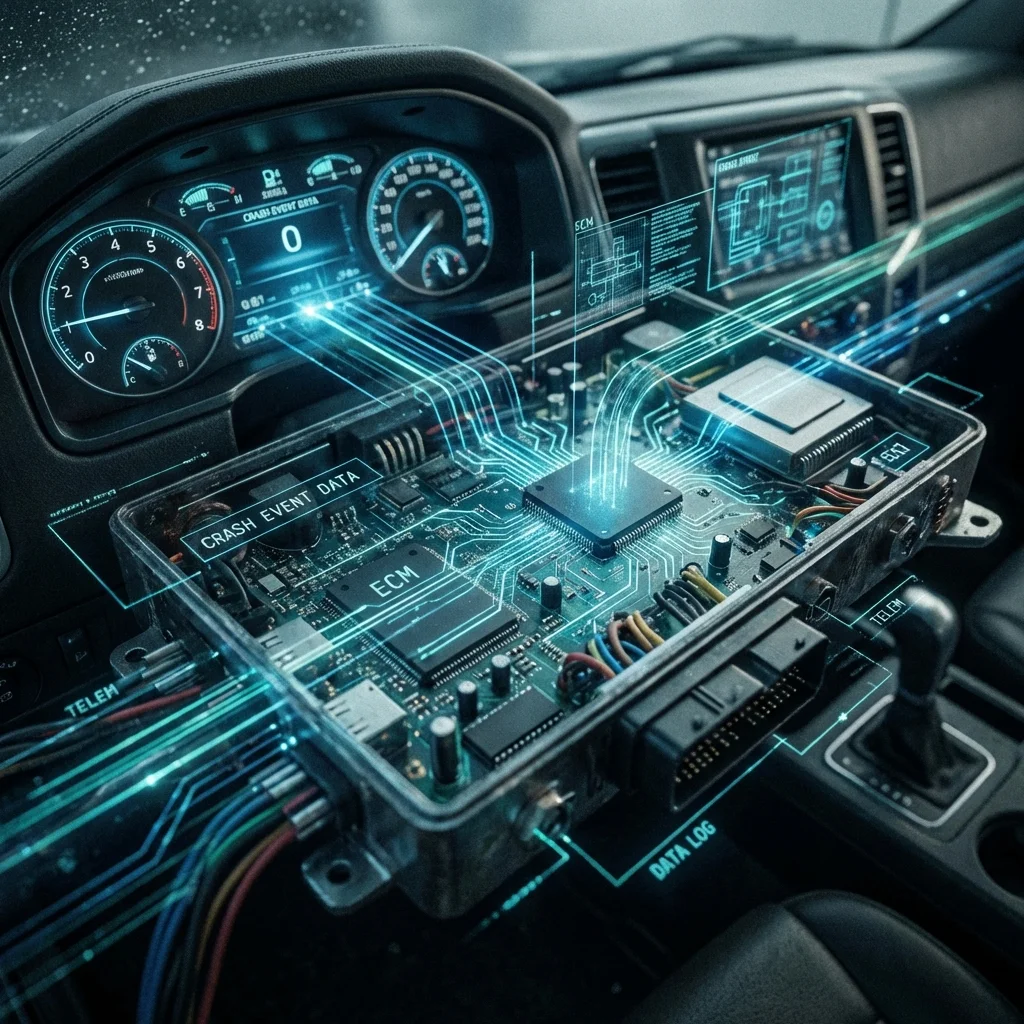
Proving this fraud requires a comparative analysis of data sources. While the ELD is easily manipulated, the Engine Control Module (ECM) is far more robust. The ECM is the powertrain's primary computer, responsible for fuel injection timing and emissions compliance. It incidentally records data that is critical for litigation, specifically "Hard Braking Events" and "Critical Stability Events."
When a modern Detroit Diesel, Cummins, or Volvo engine detects a deceleration event exceeding a specific threshold (typically 7 mph per second), it freezes a "snapshot" of the engine's state. This snapshot captures data for a window of time—often 60 seconds pre-event and 15 seconds post-event. Crucially, this data includes the "Governor Setting" and "Pedal Position."
In a serious rear-end truck collision, the ELD might show a driver traveling at 62 mph near the crash sequence while an ECM download shows a hard-braking event minutes earlier at a higher recorded speed. If the ECM also shows unusual road-speed-governor settings, that discrepancy can become important evidence. It may support questions about speed, limiter settings, carrier policies, and whether additional expert review is needed before anyone accepts the company timeline at face value.
IV. Spoliation and the "Volatile Memory" Problem
The legal preservation of this evidence is a race against time. Unlike the "Black Box" in aviation, which is designed to survive impact and retain data indefinitely, a truck's ECM has extremely limited memory storage. Most units are configured to store only the last three Hard Braking Events. If the truck is driven away from the scene, or even if it is towed to a yard and the ignition is cycled on and off during inspection, the critical crash data can be overwritten by new, irrelevant data.
This volatility creates a "Spoliation Trap." Defense counsel may argue that the data was lost in the ordinary course of business. To defeat this, plaintiffs must send a Spoliation Letter immediately—often within hours of retention—that is specifically tailored to the technical reality of the ECM. A generic "save all evidence" letter is insufficient. The letter must explicitly demand the preservation of "Last Stop Records," "Hard Brake Incidence Reports," and "Daily Usage Tips," and must instruct the carrier to disconnect the vehicle's battery terminals to prevent an ignition cycle overwriting the cache.
If the carrier fails to preserve this data after receiving such a specific notice, the court may sanction them with an "Adverse Inference" instruction. This instruction tells the jury to assume that the destroyed evidence would have been unfavorable to the defense—effectively, that the missing data contained proof of negligence. In many jurisdictions, establishing spoliation is as valuable as the data itself, as it shifts the burden of proof effectively to the defense to explain why they destroyed the evidence of their own exoneration.
V. Conclusion
The era of trusting the logbook is over. In the age of digital freight, the plaintiff's attorney must become a forensic data analyst. The discrepancy between the clean story told by the ELD and the dirty reality recorded by the ECM is often the difference between a defense verdict and a multi-million dollar judgment. We do not litigate against the driver's diary; we litigate against the machine's memory.