I. A Serious Oklahoma Crash Presented a Texas Deadline Question
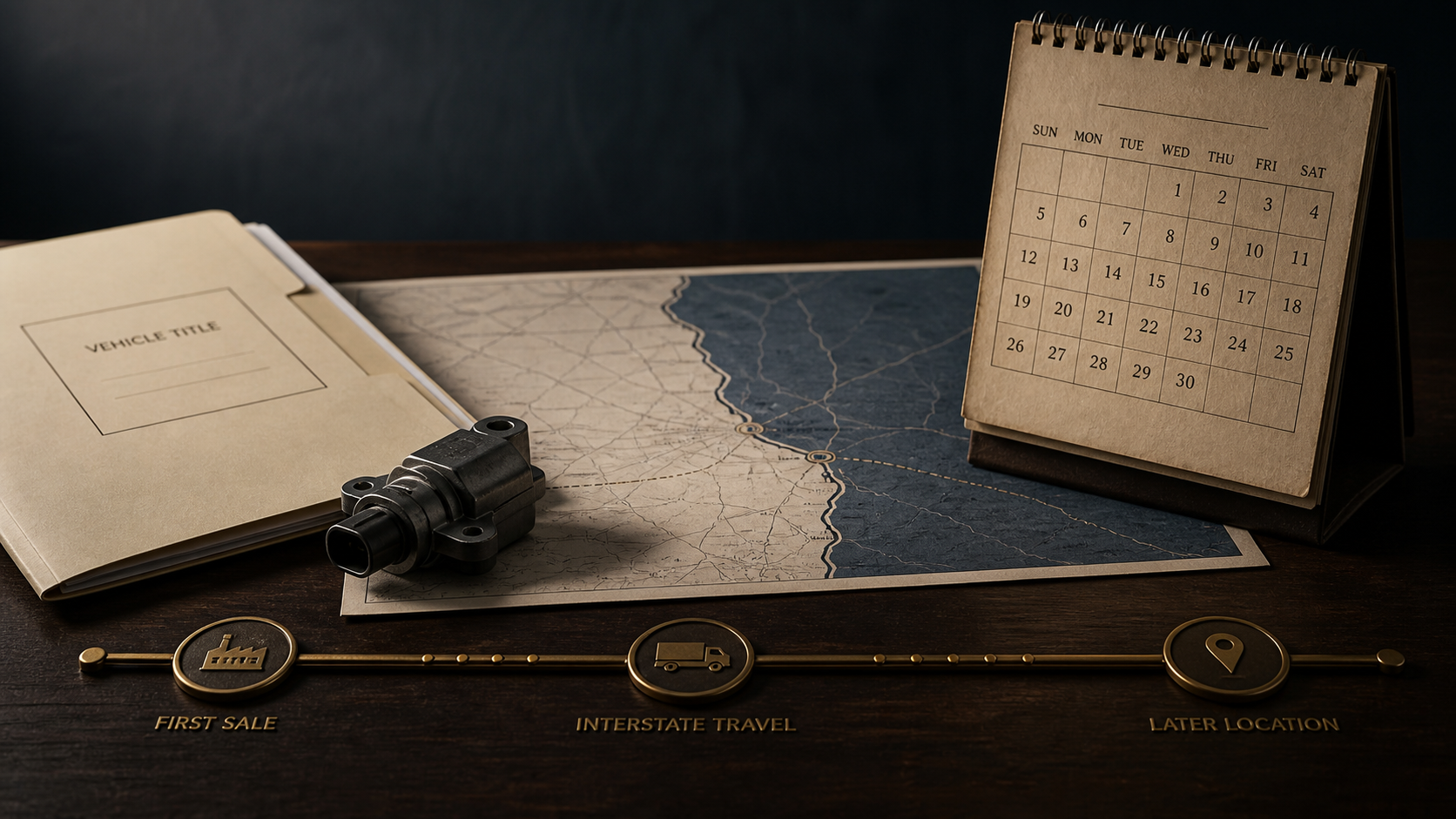
On April 14, 2026, the Oklahoma Supreme Court decided Betts v. Toyota, 2026 OK 22. Wayne and Kristin Betts brought a products-liability action after a single-vehicle rollover in Fairview, Oklahoma, left Wayne paralyzed. The opinion states that he was driving a 2002 Toyota Sequoia to a work safety meeting when the vehicle lost traction on icy roads. The plaintiffs alleged that the electronic stability control did not activate properly and failed to correct the vehicle’s path. The accident and initial medical care occurred in Oklahoma, but the vehicle and the people connected to it had substantial ties elsewhere. Toyota designed the model in Japan, manufactured the vehicle in Indiana, and first sold it in Georgia in 2002. Wayne’s grandmother later acquired it in Texas, and Wayne retitled it there. At the time of the crash, the vehicle was titled, registered, tagged, and garaged in Texas, and the Bettses were Texas residents. Those contacts created a threshold question separate from defect and causation: whether Texas’s fifteen-year products-liability statute of repose barred the action. The reproduced opinion remains marked not released for publication and subject to revision or withdrawal.
II. Summary Judgment Turned on Governing Law, Not Defect Proof
Toyota moved for summary judgment under Texas Civil Practice and Remedies Code section 16.012, which generally requires a products-liability action against a manufacturer or seller to begin within fifteen years after the defendant’s sale of the product. The vehicle’s first sale occurred more than fifteen years before the 2018 rollover. The plaintiffs argued that Oklahoma law should apply because the injury occurred here and Wayne regularly traveled to Oklahoma for work. Oklahoma does not impose the same products-liability statute of repose. The district court applied Texas law and entered judgment for Toyota. The Court of Civil Appeals reversed, but the Oklahoma Supreme Court granted certiorari, vacated the appellate opinion, and affirmed the district court. This procedural posture limits what the decision establishes. The Court did not conduct a trial about the stability-control system. It did not find that the Sequoia was safe, that icy conditions were the sole cause, or that the driver caused the rollover. The Court resolved which state’s substantive repose rule governed the right to bring the products claim on the contacts before it. A deadline ruling can end litigation without answering the engineering merits, which is why governing-law questions should be investigated at the beginning of a multistate case rather than after expert work is underway.
III. Oklahoma Uses the Most Significant Relationship Test
The Court applied the approach adopted in Brickner v. Gooden, 1974 OK 91. Oklahoma abandoned a rigid rule that always applies the law of the place of injury and instead asks which state has the most significant relationship to the occurrence, the parties, and the particular tort issue. The analysis considers where the injury occurred, where the conduct causing it occurred, the parties’ domicile or place of business, and where their relationship was centered. General considerations include the states’ policies, justified expectations, predictability, uniformity, and ease of applying the governing rule. Importantly, the inquiry is issue-specific. One state’s law may govern driving conduct while another state’s law governs capacity, immunity, or a substantive bar to suit. Betts concerned only whether Texas’s products-liability repose period controlled. The Court rejected the idea that the Oklahoma crash automatically selected Oklahoma law for that question. It also declined to adopt a Restatement provision that would make the injury state the presumptive choice in personal-injury cases, adhering instead to its established all-torts framework. For counsel, the lesson is to name the exact disputed issue before counting contacts. A broad statement that “the case happened in Oklahoma” does not determine which law governs every right, defense, deadline, evidentiary rule, or damages issue.
IV. The Place of Injury Was Real but Not Controlling
The rollover and catastrophic injury occurred in Oklahoma, and the Court recognized Oklahoma’s interest in the safety of its roads. Yet it regarded the accident location as incidental for the particular repose issue. A products-liability claim focuses on whether a defect existed when the product left the manufacturer or seller’s control. A statute of repose likewise runs from a defined historical event—here, the manufacturer’s sale—not from the injury or discovery of harm. The relevant product history stretched across several jurisdictions before the vehicle entered Oklahoma for a temporary work trip. The vehicle was primarily used and garaged in Texas. Its owner left Texas for work and intended to return. The Court reasoned that the right to pursue a products claim should not ordinarily change merely because that Texas vehicle crossed a state line. This does not mean the injury location is unimportant in every case. The Court’s analysis repeatedly stressed the facts and the specific issue. A product routinely sold, serviced, marketed, or based in Oklahoma may present a different grouping of contacts. So might resident plaintiffs, an Oklahoma seller, an Oklahoma-centered commercial relationship, or conduct occurring here. Betts is a method for weighing connections, not a universal rule that registration alone always controls.
V. Product History Drove the Repose Analysis
The opinion treated the product’s life history as central. Toyota’s alleged design and manufacturing conduct occurred outside both Oklahoma and Texas, so those locations did not resolve the two-state dispute. The initial sale occurred in Georgia. The later family transfer, title, registration, garage location, and primary use were tied to Texas. The plaintiffs were Texas residents when the accident occurred, Wayne held a Texas commercial driver’s license, and he returned to Texas for most of his medical care. His Oklahoma work assignments were periodic and temporary. The Court concluded that Texas had the stronger relationship to the right-to-sue question and an interest in regulating products owned and used there. It also emphasized the policy behind repose: protecting manufacturers and sellers from indefinite potential liability after a defined time. Oklahoma’s competing roadway-safety interest carried less weight because the vehicle was only incidentally present rather than based here. These facts show why product cases require more than crash evidence. Title history, bills of sale, registration, garage location, maintenance and repair records, recalls, warranty work, ownership transfers, mileage, principal use, seller identity, and the manufacturer’s distribution record can determine which substantive law applies. If those records disappear, counsel may lose the ability to prove not only defect but also which jurisdiction has the strongest relationship to a dispositive issue.
VI. A Statute of Repose Is Not an Ordinary Limitation Period
The plaintiffs invoked Oklahoma’s borrowing statute, which addresses limitation periods for claims accruing outside Oklahoma. The Supreme Court explained that a statute of repose is substantive rather than merely procedural. It can extinguish the right to sue after a period measured from an event such as sale or completion, even if injury occurs later. A conventional statute of limitations commonly begins with accrual of the claim and may involve discovery or tolling questions. Because Texas’s repose statute affected the parties’ substantive rights, the Court selected governing law through the most-significant-relationship analysis instead of treating the matter as an ordinary procedural deadline. The Court also noted that all parties agreed the claim accrued in Oklahoma, making the borrowing statute inapplicable for an additional reason. This distinction is consequential in older-product cases. The injured person may act promptly after the accident and still encounter a repose bar based on an initial sale years earlier. Counsel should identify the product’s original sale or delivery date immediately and investigate whether any statutory exceptions, express warranties, replacement components, later sales, or separate claims affect the analysis. Betts did not decide hypothetical exceptions or every other cause of action. Its holding concerns the Texas products-liability repose rule applied to the record before the Court.
VII. Preserve the Product Before the Legal Map Is Complete
Choice-of-law research should begin early, but it should not delay physical evidence preservation. A rollover vehicle may contain event data, stability-control information, diagnostic trouble codes, restraint-system evidence, tire and wheel condition, steering and suspension components, roof-deformation evidence, photographs, measurements, and repair or maintenance history. The vehicle should not be altered, salvaged, released, destructively tested, or transferred without a documented preservation plan and appropriate notice. Original electronic data and metadata should be retained when lawful and available. At the same time, the case team should build a jurisdictional chronology: where the product was designed, manufactured, first sold, resold, titled, garaged, serviced, recalled, and principally used; where each party resided or did business; and where the relationship between buyer, seller, and manufacturer was centered. These parallel tracks serve different purposes. Engineering evidence addresses defect and causation. Contact evidence addresses governing law. Medical evidence addresses injury and damages. Betts ended on the governing-law track without reaching the engineering track, but that outcome could not safely be assumed when the case began. Preservation must therefore protect every viable path while counsel tests threshold barriers. This article does not advise any person to access proprietary vehicle data or evidence without lawful authority and qualified assistance.
VIII. Multistate Cases Need an Issue-by-Issue Deadline Audit
A serious injury involving interstate travel, an out-of-state product, or nonresident parties should trigger a written choice-of-law and deadline audit. The audit should identify every potentially interested jurisdiction and compare statutes of limitation and repose, accrual and discovery rules, tolling provisions, product-liability standards, damages restrictions, comparative-fault rules, evidentiary provisions, and available claims. It should then connect each disputed issue to the contacts that matter for that issue. The place of injury may dominate one question and carry less weight on another. Counsel should avoid assuming that the forum’s law controls simply because suit can be filed there, or that one selected state’s law necessarily governs the entire case. The analysis also must be revisited when discovery changes the known contacts—for example, when records identify a different seller, a component manufacturer, a warranty promise, or substantial local service work. Filing strategy cannot rest on a blog summary or a vehicle’s current registration alone. Statutory text, current appellate authority, contractual provisions, and the complete factual record must be reviewed. Betts makes the cost of a missed conflict visible: the plaintiffs’ Oklahoma accident and Oklahoma filing did not prevent another state’s substantive repose rule from ending the products claim.
IX. Read Betts Narrowly and Act Early
The holding in Betts is precise. Under the facts presented, Texas had the most significant relationship to whether its products-liability statute of repose applied to a Texas-owned, Texas-titled, Texas-registered, and Texas-garaged vehicle temporarily driven into Oklahoma, and that statute barred the claim. The decision does not establish that Texas law governs every issue in every crash involving a Texas resident or vehicle. It does not decide the alleged defect, accident causation, comparative fault, damages, or the merits of any claim outside the products-liability repose issue. Justice Combs is listed as dissenting, but the reproduced decision includes no dissenting opinion, so no rationale should be attributed to that vote. Because the opinion remains marked not released for publication, lawyers should verify its current official text, status, and later treatment before reliance. The durable practice lesson is early jurisdictional discipline. Preserve the product and data, reconstruct ownership and sale history, identify every relevant state, and determine which law governs each potentially dispositive issue before time and evidence are lost. This article provides general information, not legal advice or a prediction about any case. Hicks Law Firm evaluates serious Oklahoma injury and product matters from the actual evidence, parties, product history, deadlines, and governing law. Past results do not guarantee future outcomes.
If a defective vehicle or other product may have caused a catastrophic injury, preserve the product, photographs, ownership records, service history, and communications before anything is repaired or destroyed. Contact Hicks Law Firm at (405) 759-0515 or through the contact page. Do not send confidential details until an attorney-client relationship has been established. Every matter depends on its own evidence, jurisdictions, claims, and deadlines.