I. The Physics of Inequality
There is a violence inherent in the mathematics of the interstate. It is the violence of mass times acceleration, a formula that cares nothing for the sanctity of human life or the statutes of the State of Oklahoma. When a fully loaded commercial tractor-trailer, weighing 80,000 pounds, travels at 75 miles per hour, it generates a kinetic energy that is less like a vehicle and more like a tactical missile. The driver of a Honda Accord, encased in perhaps 3,500 pounds of steel and glass, exists in a state of perilous asymmetry. This disparity is not merely physical; it is legal. The semi-truck is not just a machine; it is a jurisdiction unto itself. It is a sovereign entity of commerce, protected by a phalanx of insurance adjusters, federal regulations, and a legal doctrine designed to sanitize the bloodshed it creates.
We are conditioned to call these events "accidents." The trucking industry prefers the term "occurrences." Both words are lies. They imply unpredictability, a twist of fate, an act of God. But in the forensic reality of the highway, there are no accidents. there are only systems operating exactly as they were designed. When a logistics company mandates a delivery schedule that requires speeding, the resulting crash is not a bug; it is a feature. When a safety manager ignores a driver's failed drug test to keep a rig moving, the subsequent fatality is not a tragedy; it is a transaction. The road is the ledger where these transactions are settled, and the currency is the life of the Oklahoma citizen.
The central conflict of modern trucking litigation is not determining who ran the red light. The onboard telematics and dashcams usually answer that question in milliseconds. The true conflict is the battle to expand the scope of liability beyond the cockpit of the truck. The defense bar, representing the multi-national carriers, seeks to contain the "blast radius" of the lawsuit to the individual driver—the "hand" on the wheel. The plaintiff's bar, if it is doing its job, seeks to trace the nerve impulse back to the "brain"—the corporate boardroom where the decisions to cut corners were made. This battle is fought on the terrain of a specific, controversial Oklahoma legal doctrine known as Jordan v. Cates.
II. The Shield of Jordan v. Cates
In 1997, the Oklahoma Supreme Court handed down a decision that became the Magna Carta for negligent trucking companies. In Jordan v. Cates, 1997 OK 9, 935 P.2d 289, the Court held that if an employer stipulates that an employee was acting within the course and scope of their employment, then any direct negligence claims against the employer (such as negligent hiring, training, or retention) are "unnecessary and superfluous" and must be dismissed. The logic seems sound on the surface: if the company admits it is liable for the driver's actions via respondeat superior, why do we need to litigate the company's hiring practices? The victim gets paid either way, right?
This is the "Jordan Shield." It is a procedural sleight of hand that allows a corporation to buy its way out of scrutiny. By admitting a smaller liability (that the driver made a mistake), they inoculate themselves against a massive liability (that the company is systemically dangerous). It is the equivalent of a mob boss admitting that his hitman pulled the trigger, to prevent the police from investigating who ordered the hit. The result is a sanitization of the trial. The jury sees only a tired driver who made a bad split-second decision. They do not see the safety director who hired a driver with three prior DUIs because he was "cheap." They do not see the dispatcher who threatened to fire the driver if he took a nap. They see the effect, but they are legally blinded to the cause.
For decades, this doctrine allowed the "Corporate Sin" to remain hidden. Trucking companies could run slipshod operations, hire unqualified drivers, and skip safety training, knowing that as long as they admitted the driver was "on the clock," their own institutional recklessness would never see the light of day in a courtroom. It turned the concept of respondeat superior—originally a tool to help victims recover—into a bunker for corporate malfeasance. It reduced the 18-wheeler to a rogue agent, severing it from the hive mind that directs it.
III. Piercing the Veil: Fox v. Mize and the Punitive Exception
The law, however, is a living organism. It evolves when the pressure of injustice becomes too great to contain. That evolution arrived in 2018 with the landmark decision of Fox v. Mize, 2018 OK 75, 428 P.3d 314. In Fox, the Oklahoma Supreme Court finally recognized the gaping hole in the Jordan logic. The Court held—crucially—that the Jordan rule does not apply when the plaintiff seeks punitive damages against the employer for its own independent misconduct. This was the seismic shift that shattered the shield.
Under Fox, if we can plead and prove that the trucking company acted with "reckless disregard" for the rights of others—for example, by knowingly entrusting a lethal vehicle to a driver they knew was incompetent or impaired—the admission of "course and scope" does not save them. The Court recognized that holding an employer liable for the driver's negligence is fundamentally different from punishing the employer for its own gross negligence. The former compensates the victim; the latter punishes the corporation. To conflate them is to grant immunity for corporate recklessness.
This distinction is not academic; it is the difference between a settlement and a reckoning. It transforms the discovery process. We are no longer limited to asking the driver, "Why didn't you stop?" We are empowered to ask the Safety Director, "Why did you put him in the truck?" We can demand the hiring files, the training logs, the Qualcom messages, and the internal emails where profit was weighed against safety. Fox v. Mize is the license to hunt the Leviathan. It acknowledges that a corporation has a separate moral existence from its employees, and that it must be held separately accountable for its sins.
IV. The Reptile's Logic
Why do trucking companies fight so hard to keep these claims out? Because they understand the "Reptile Logic" of the jury. A jury might forgive a driver who sneezed and drifted into a lane. Humans make mistakes. But a jury will never forgive a corporation that looked at a driver's record of drug abuse and said, "Hire him anyway, we need the load moved by Tuesday." That is not a mistake; it is a calculation. It is a betrayal of the public trust.
The trucking industry operates on razor-thin margins. Safety is expensive. Background checks take time. Training costs money. Sleep apnea tests are a hassle. In the absence of punitive consequences, the "rational" economic decision for a carrier is often to cut these corners. They calculate the cost of a future wrongful death lawsuit as a line item in the budget—the "cost of doing business." Jordan v. Cates subsidized this calculation by ensuring that the lawsuit would be limited to the driver's error, keeping the verdict manageable.
But when Fox v. Mize puts punitive damages on the table, the math changes. Punitive damages are not an expense; they are an existential threat. They are designed to "sting." They are uninsurable in many contexts. They force the Board of Directors to pay attention. By piercing the veil of Jordan, we are not just winning a case; we are rewriting the economic incentives of the industry. We are making it too expensive to kill people.
V. The Mandate of Litigation
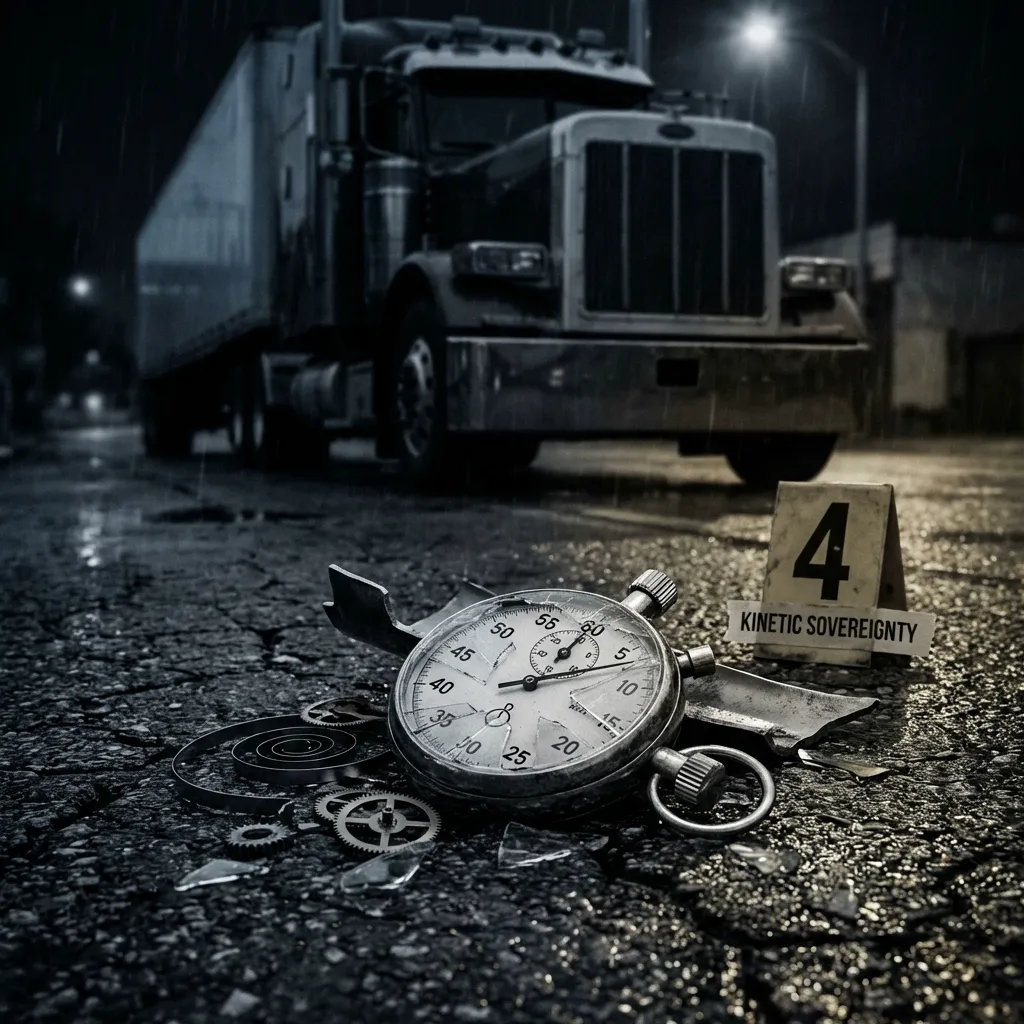
The mandate of the civil justice system is not merely to redistribute money. It is to enforce the standards of civilization. The interstate highway is a commons—a shared space where a family in a minivan has as much right to exist as a consolidated freight hauler. The concept of "Kinetic Sovereignty"—the idea that the sheer mass and economic power of the truck grants it immunity from the rules of the road—is an affront to the rule of law.
When we file a lawsuit against a trucking company, we are asserting the sovereignty of the citizen. We are stating that the Constitution and the Common Law apply with equal force to the entity with the DOT number as they do to the individual. We reject the "accident" narrative. We reject the "rogue driver" scapegoat. We insist on looking behind the curtain to the systems that put that driver on that road at that moment.
In the end, Fox v. Mize is more than a case citation. It is a weapon of self-defense for the public. It ensures that when the "Corporate Sin" leads to the shedding of innocent blood, the corporation cannot hide behind its own employee. It must stand in the well of the court, naked and exposed, and answer for the choices it made in the dark. This is why we litigate. Not for the tragedy that happened, but for the tragedy we can prevent by making the cost of negligence higher than the cost of safety.