I. The Definition of a Citizen
The United States is not a geography. It is not the amber waves of grain, nor the purple mountain majesties. It is a specific, radical, and dangerous idea: that the Individual is sovereign, and the State is a servant. This inversion of the historical order—where for thousands of years the King was the father and the subject was the child—is codified in the Bill of Rights. These first ten amendments are not "privileges" granted by a benevolent government; they are the "Social Contract" made visible. They are the non-negotiable terms of surrender under which we, the people, agree to be governed at all. The Fourth Amendment, the right to be "secure in their persons," is the most physical and intimate of these terms. It is the line in the sand—or in the pavement of a Minneapolis sidewalk—where the overwhelming power of the Leviathan must stop.
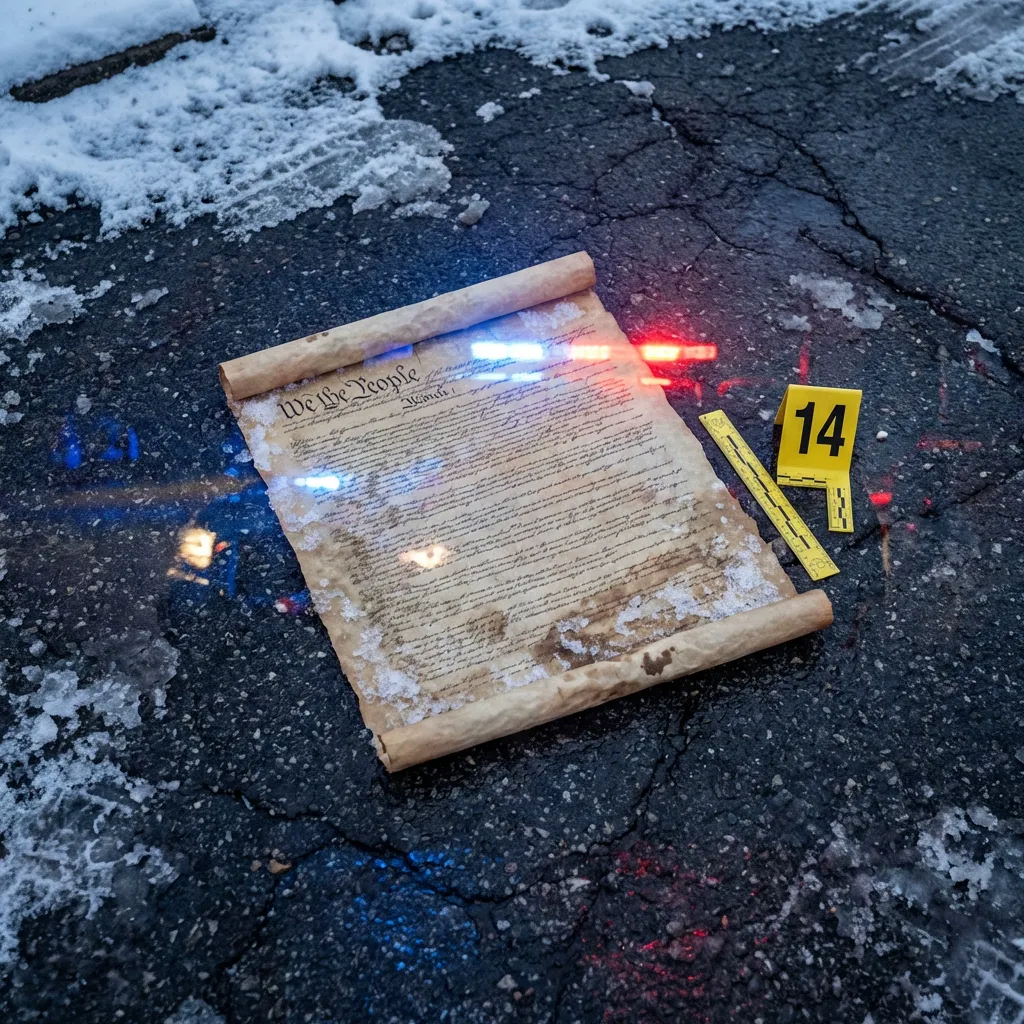
When we look at the Fourth Amendment, we must not see a regulation for police conduct. We must see the definition of the American Citizen. To be a citizen is to possess an inviolable sphere of self-ownership. It means that your body is your own, and that no agent of the state, no matter how badge-heavy or terror-driven, can breach that sphere without a justification that is mathematically precise and objectively reasonable. If the government can tackle you, blind you, disarm you, and then shoot you without recourse, you are no longer a citizen. You are a biological asset of the state, allowed to exist only so long as you remain compliant and convenient. The bullet that struck Alex Pretti did not just pierce the heart of an intensive care nurse; it pierced the parchment of 1791. It raised the terrifying question: Does the Constitution still exist, or is it merely a ghost story we tell ourselves to feel free?
The modern civil-rights problem is that legal doctrines can make accountability difficult even when a family has serious questions about a law-enforcement death. Qualified immunity, federal-remedy limits, and Egbert v. Boule can narrow the path before a court ever reaches the full factual record. This article looks at the public account of Alex Pretti's death as a Fourth Amendment problem: what facts were known, what remains disputed, what force was used, and what legal remedy may exist if the record supports a constitutional violation.
II. The Forensic Reality
To understand the violation, we must understand the physical reality, stripped of the government's ex post facto narratives. It was January 24, 2026. The air in Minneapolis was brittle with cold. Alex Pretti, a 37-year-old man who had spent his career in the high-stakes environment of an Intensive Care Unit—a place where "split-second decisions" preserve life, rather than take it—stood on the sidewalk. He was armed. This fact is crucial, not because it justifies his death, but because it affirms his status. He was a legal gun owner, exercising his Second Amendment right while engaging in his First Amendment right to protest. He was the embodiment of the "check and balance" the Founders envisioned: a citizen, armed and vocal, holding the state accountable.
The incident began with the government's initiation of force. A Border Patrol agent, part of the "Operation Metro Surge" deployment, physically pushed a female protestor. Pretti intervened. This intervention was the catalyst. It is vital to note that Pretti did not draw his weapon. He did not threaten alone. He verbally objected to the abuse of power. In response, the agents did not de-escalate; they swarmed. This is the instinct of the occupying force: any challenge to authority is met with overwhelming violence. They deployed chemical irritants—pepper spray—effectively blinding him. Then, they tackled him to the ground. In the lexicon of the Fourth Amendment, this was the "Seizure."
The government's narrative reportedly centers on whether Pretti reached for a gun. In any deadly-force review, that kind of claim must be tested against the complete record: video, timing, witness accounts, officer positions, weapon location, commands, lighting, and whether the person still posed an immediate threat when shots were fired. If the public record ultimately shows that the firearm had already been removed or secured, that sequence would become central to the Fourth Amendment analysis. The legal question is not rhetoric; it is whether the facts, viewed objectively, made deadly force reasonable at that moment.
III. The Character Defense: A Legal Distraction
In the wake of the shooting, the government has attempted to litigate Alex Pretti's character rather than the agent's conduct. We hear reports that days prior, Pretti kicked a police car. We hear that he "interfered" with the agents' operation. These facts are presented to the public as a sort of moral justification for his death—as if to say, he was a criminal, so he forfeited his right to live. This line of reasoning is not just morally repugnant; it is legally irrelevant under the strict standards of Fourth Amendment jurisprudence.
The Supreme Court held in Graham v. Connor, 490 U.S. 386 (1989), that the "reasonableness" of a particular use of force must be judged from the perspective of a reasonable officer on the scene, focusing on the facts and circumstances at the moment force is used. This is a temporal constraint. It means that "reasonableness" has an expiration date. An act of vandalism committed 48 hours ago—kicking a car—is too remote in time to justify present deadly force. Unless the specific agent who pulled the trigger knew of that prior act and had reason to believe it indicated a specific, present propensity for immediate deadly violence, it is admissible only as character assassination, not as legal justification. You cannot shoot a man on Tuesday for a misdemeanor property crime he committed on Sunday.
Furthermore, even if the agents knew of the prior act, the law does not permit the use of deadly force to retrofit a punishment for past behavior. Police officers are not judges. They are not executioners. They are agents of the peace whose authority to use force is strictly bounded by the immediate necessity of defense. Once the threat is neutralized—once the gun is removed and the suspect is pinned—the authority to kill vanishes. It does not matter if Pretti was a saint or a sinner. It does not matter if he was "interfering" (a crime under 18 U.S.C. § 111). The remedy for interference is arrest. The remedy for vandalism is an indictment. The remedy is never a summary execution on the pavement. To argue otherwise is to argue that the Fourth Amendment only protects the innocent, which is to say it protects no one at all.
IV. The Elements of Seizure
The legal framework for analyzing this tragedy is found in Tennessee v. Garner, 471 U.S. 1 (1985). In Garner, the Court held that it is unconstitutional to use deadly force to prevent the escape of a fleeing suspect unless the officer has "probable cause to believe that the suspect poses a threat of serious physical harm." But Pretti was not fleeing. He was pinned. The analysis returns to Graham and the "Objective Reasonableness" standard. We must ask: Would a reasonable officer, standing in the shoes of the agent, believing what he believed at the split-second of the shooting, have found it necessary to kill?
Let us construct this "reasonable officer." He is trained. He is aware of the law. He knows that once a suspect is disarmed and restrained, the authorization for deadly force evaporates instantly. The "Split-Second Doctrine" protects officers who make mistakes in the heat of battle, but it does not protect officers who ignore reality. The reality was a secure weapon. If the weapon is in the agent's hand, it cannot be in the suspect's hand leading to a threat. To shoot a man for reaching for a gun you are already holding is not a mistake; it is a hallucination or a homicide. Under Graham, the "severity of the crime" (protesting/obstructing) was low. The "threat to safety" (zero, post-disarmament) was non-existent. The "attempt to evade" (impossible, pinned) was null. By every metric of the objective standard, the killing of Alex Pretti was a violation of the Fourth Amendment so egregious that it defies defense.
The "Interference" argument crumbles under this scrutiny. Yes, Pretti interfered. Yes, that is a crime. But in a constitutional republic, we do not execute citizens for misdemeanors, or even for felonies, without due process of law. The agents had the physical control necessary to effectuate an arrest. They chose, instead, to effectuate a death sentence. This choice transforms them from law enforcers into law breakers of the highest order.
V. The Void and the Verdict
Why does this matter? Why should a reader in Oklahoma care about a shooting in Minneapolis? Because boundaries matter. Not the borders between nations, but the boundaries between Power and Right. The Bill of Rights is a list of things the government cannot do. It is a restraining order against the Leviathan. When we allow that restraining order to be violated without consequence, we are not just failing Alex Pretti; we are dismantling the structure of our own freedom. We are accepting the premise that the government's monopoly on violence is absolute and unreviewable.
The Founders were obsessed with the danger of Standing Armies. They cited the British Army's abuses—the warrantless searches, the quartering of troops, the summary executions—as the primary grievance of the Declaration of Independence. ICE, in its current formulation—militarized, unaccountable, operating deep within the interior—is precisely the Standing Army the Founders feared. They operate with the mindset of war in the streets of peace. When they killed Pretti, they were acting out the grim logic of a force that views the population not as constituants, but as potential combatants. This is the antithesis of the American idea.
And so we come to the void. The final insult of the Pretti case is not the death, but the silence that follows. Under the doctrine of Egbert v. Boule, the Supreme Court has effectively immunized federal agents from civil liability. They have ruled that "national security"—a term so broad it encompasses everything and means nothing—trumps the citizen's right to redress. They have told the Pretti family, and all of us, that while the Constitution forbids the shooting, the Court will not punish it. A right without a remedy is a ghost. It haunts the law, but it does not touch the world. If we wish to remain a free people, we must reject this jurisprudence of impunity. We must demand that the Fourth Amendment be restored to its rightful place: as the supreme law of the land, superior to any badge, bureaucrat, or political party.